Erika Kirk, Joe Biden, and the “Correct” Way to Grieve

Is there a “right” way to grieve after losing a spouse—or are we just projecting our discomfort onto other people’s pain?

Hey everyone, I’m Abel Keogh, author of the book Dating a Widower, and today we’re talking about the so-called “correct” way to grieve. And yes, I’m using air quotes around correct—because everyone seems to have strong opinions about how someone should grieve after losing a spouse—especially people who’ve never lost one.

Take Erika Kirk, the widow of Charlie Kirk. After her husband’s murder last year, she grieved in a very public way. She gave speeches, did interviews, and stepped into a leadership role in her late husband’s organization. And almost immediately, the internet went to work. Armchair critics—people with plenty of opinions and zero lived experience—decided she was “moving on too fast” or “not grieving correctly.” Some even accused her of abandoning her children in pursuit of fame and fortune.

Of course, almost none of these people have ever buried a spouse. But that didn’t stop them from judging.

Here’s the truth: grief is deeply personal. Some people cry constantly. Some throw themselves into work. Some need quiet. Some need purpose. All of it can be normal—because grief doesn’t follow a timetable or a rulebook. And until you’re actually in that position, you have no idea how you’d respond.

If you’re still convinced Erika Kirk is grieving “the wrong way,” let me give you another example.

In November of 1972, a relatively unknown lawyer named Joe Biden was elected to the U.S. Senate by just over 3,000 votes. At twenty-nine, he became one of the youngest senators ever elected. Five weeks later, his entire world collapsed.

On December 18, while Biden was in Washington, D.C., interviewing potential staff, his wife, Neilia, took their three children out to buy a Christmas tree. Their car was struck by a semi-truck. Neilia and their one-year-old daughter, Naomi, were killed instantly. Biden’s two young sons, Beau and Hunter, were critically injured.

Suddenly, Biden faced an impossible choice: resign before ever taking the oath of office—or try to serve while barely holding himself together. With his colleagues' encouragement and knowing how hard he and Neilia had worked to get there, he agreed to give the job a six-month try. In January 1973—less than a month after losing his wife and daughter—Joe Biden took the oath of office at his son’s hospital bedside.

Most of you know how this story ended. He pushed through his grief and, with help, raised his sons. He remarried a few years later. He served in the Senate until 2009, then as Vice President for eight years, and in 2020 was elected President of the United States.

So let me ask you honestly: should Joe Biden have resigned and walked away? Was it “too soon” for him to serve? I ask because if you’re going to judge one public figure by that standard, are you willing to apply the same standard to all of them?

From my own loss—and from talking with thousands of widows and widowers over the years—I’ve learned this: there are healthy ways to grieve, and there are unhealthy ones. Having purpose matters. Channeling your energy into work, family, service, or honoring the person you lost is usually healthy. What Joe Biden did—and what Erika Kirk is doing—is far healthier in the long run than numbing the pain with drugs, alcohol, or reckless behavior. Those things don’t heal grief. They delay it and make it worse.

So the next time a public figure—or someone in your own life—loses a spouse, resist the urge to criticize and police their grief. Instead of firing off an emotional social-media post, pause and ask yourself a better question: Is what they’re doing helping them survive—or am I just uncomfortable with how their pain looks?

Grief doesn’t need commentary. It needs compassion. Mourn with people, not at them. Show up. Offer help. Sit in the discomfort instead of trying to control it.

Widows and widowers have to be strong—not because they don’t feel pain, but because their lives have been permanently altered. Bills still come due. Children still need parenting. Decisions still have to be made. Survival isn’t optional; it’s necessary. And when someone is doing the best they can to keep moving forward, your criticism doesn’t heal anyone’s grief or bring a loved one back—it only adds weight to a burden they’re already struggling to carry.

Erika Kirk and Joe Biden didn’t choose the tragedies that reshaped their lives—but they did choose how to respond. They chose purpose over paralysis. Movement over collapse. And whether you agree with their choices or not, those choices were theirs to make—not ours to judge.

There is no universal timetable for grief. No checklist. No “right” way that applies to everyone. Grief is personal. Survival is personal. And until you’ve stood in that place yourself, the most honest thing you can say is not “Here’s what you should do,” but “How can I help?”

I’m Abel Keogh, author of Dating a Widower. Thanks for watching—and I’ll see you next Wednesday.

Thomas Massie and the Grief Police

Note: Watch the short video version of this here.

The internet is furious again — and this time, it’s because a widower dared to rebuild his life. Kentucky Representative Thomas Massie announced on social media that he recently got married to former congressional staffer Carolyn Grance Moffa — just 16 months after his late wife, Rhonda, passed away unexpectedly. And almost immediately, the grief police showed up in full force. They criticized him for marrying “too soon,” accused him of not loving his late wife enough, and even threw around accusations that the relationship must have begun before Rhonda died.

Here’s what most people don’t realize: it’s actually very common for widowers to remarry relatively quickly. It’s also common for them to marry someone already in their social or professional circle — someone they already know and trust. None of Massie’s behavior is unusual. The real issue is that our society doesn’t understand how grief works or how men process loss, and that ignorance leads to misconceptions, judgment, and guilt.

Now, some of you might be wondering, “How do you know he was ready to open his heart again?” The truth is, I don’t know Representative Massie personally — but neither does anyone else criticizing him online. And that’s the point. We don’t get to determine someone else’s emotional readiness just because it doesn’t line up with what we think we might do.

Grief doesn’t follow a schedule. There isn’t a calendar where you flip to month sixteen and suddenly receive permission to date again. It’s a deeply personal, invisible process that plays out differently for every human being. The heart doesn’t forget, it grows. Love is not a limited resource and when someone finds the courage to open their heart after devastating loss, that should be something we honor, not attack.

And if you’re a widow or widower who chooses not to date or remarry — or you believe you would never date again if your spouse passed — that’s fine. That’s your choice. But it’s not morally superior. You don’t earn virtue points for remaining alone forever.

So please — stop policing the grief of others. Stop telling widows and widowers how long they’re required to suffer. Life doesn’t end when a spouse dies. It continues. And for those who find love again, we should celebrate the new chapter, not shame them for turning the page.

I’m Abel Keogh, author of Dating a Widower. Thanks for watching, and we’ll see you next week.

Grief Actually Ends and that’s Okay

I’m so sick and tired of the narrative that you never get over loss and that you carry it with you forever, as described in the picture below. It’s a lie that holds people back from moving forward with their life after loss. You are NOT an object. You can act. You can decide. You have the power to do for yourself what you CHOOSE to do.

Is there any other set of circumstances where we tell people that they can’t figure things out and start a new chapter? Do we tell people that lost a job that they’ll carry this loss around and never find employment again? To we tell divorced folks they can never move forward and be happy? When your child goes through a difficult time in school or life do we tell them they’ve got to carry this around for the rest of their lives? Of course not! So why do we do it with those who have lost a spouse, a child, a parent, or some other loved one?

We learn, we grow, and we heal from our experiences. Loss is no different. It’s doesn’t have to be a burden that we carry throughout our life. You can free yourself from your burden of grief and loss and be happy once again IF you want to move forward and do the hard work it takes to achieve it.

So next time someone tells you that grief never ends (and that’s okay), don’t buy into the lifetime of sadness they’re selling. Instead roll up your sleeves and use your God-given agency to move forward and do the work to lighten your burden. You, not loss, is in charge of your life. Move forward, act, and choose to be happy.

The End of Grief, Part 1

Grief is NOT something that you have to live with for the rest of your life. Grief can come to a happy end. In the first of a two part series, I share stories of those who have overcome grief and why expecting people to grieve forever sets them up for a lifetime of misery.

Chrissy Teigen, Loss, and Our Collective Inhumanity

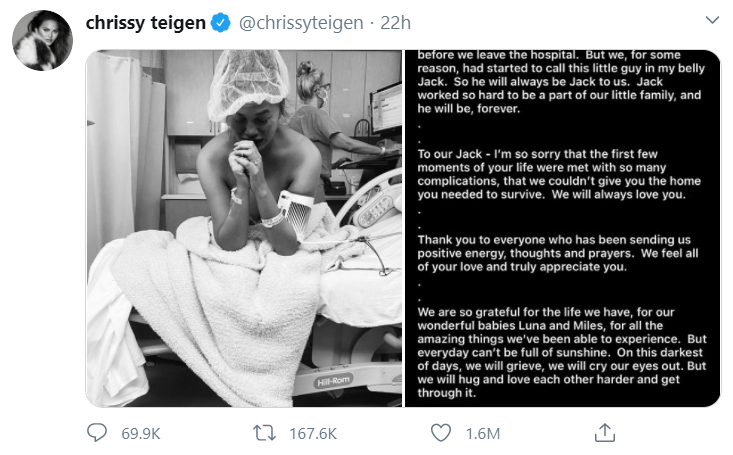
Yesterday Chrissy Teigen posted a photo of her sitting in a hospital bed after miscarrying her 18-week old baby, Jack, and the internet exploded. Some accused Teigen of milking her tragedy to increase her social media following. Others said she was a hero for expressing her loss and grief. Others wondered why anyone would share, let alone take, a photo of such a personal, tragic moment.

ct.png

As someone who has lost a child and is tired of the continued divisiveness that’s encouraged by social media, I will say this: Losing a child is the worst thing anyone can experience. It doesn’t matter if it was a miscarriage, a stillbirth, a child who died soon after birth, or any other age. It sucks more than words can describe. Losing a child is something I’d never wish on anyone for any reason. My daughter, Hope, was born nearly 3 months early and died 9 days after her birth. That was 18 years ago, and I still feel an occasional flash of pain from losing her.

Social media wasn’t a thing in 2001 so I have no idea how I would have announced Hope’s death. Maybe I would have included a photo of her. Maybe it would have just been a couple of sentences. Maybe I would have let someone else post about it because taking Hope off life support was such a gut-wrenching experience that I may not have had the strength to do it. I do know that if I lost Hope in 2020, whatever I shared probably would have generated a similar reaction as Teigen (albeit on a far smaller scale).

One of many problems with social media is that it’s made everyone think they’re mind readers. For example, someone posts their support for Donald Trump and those who disagree accuse her of supporting white supremacy. Someone posts their support for Joe Biden and she’s accused of being a socialist. Teigen posts a photo of her grief and millions of people can suddenly read her mind and know her motivations for announcing it.

The truth is I have no idea why Teigen posted the photo and accompanying message and you don’t either. I hope it was because it was a sincere expression of grief and pain she’s going through and not to increase her social media presence. (If she posted it for likes or to grow her audience then I have absolutely no sympathy for her situation.)

Sadly, social media has become performance art making it nearly impossible to tell who sincerely sharing something and who’s just looking for more likes, shares, and clicks. The varied response to Teigen’s announcement and photo proves it.

The only person who knows why Teigen posted the photo and announcement is Teigen herself. And since none of us can read her mind maybe the best course of action is to either assume the best of intentions or say (or post) nothing in response. (Side note: maybe give your social media friends the same benefit of the doubt when the post something about politics or anything else you disagree with. Always attributing the worst motives to those who disagree might make you feel awesome but it comes at the cost of your soul.)

As for taking photos of such personal, tragic moments, back in 2001 I wasn’t happy that my parents took a lot of pictures of Hope’s brief life and funeral. I had so much going on that documenting the event was the last thing I cared about. But after life calmed down I was grateful for the photos. And though I doubt I would have shared them on social media, they brought me much comfort when I was in a state of mind to appreciate them.

Finally, If I had the chance to say anything to Teigen, it would be this: I’m sorry for the unexpected loss of your son, Jack. I hope that you can reach a point where you can find peace and understanding from this event. I’m praying for you and hope that God will give you the strength to move forward one day, one hour, and one minute at a time.

How to Write a (Grief) Memoir

Since this post is on memoirs, a bit of shameless self-promotion: I’m teaching a memoir writing class in Ephraim, Utah on April 9. Don’t have full details as to where the class will be taught but it is part of Write Here in Ephraim Conference that will include many other wonderful authors and presenters. Stay tuned for details. If you’re in the area and want to know the ins and outs of memoir writing, I’d love to have you attend.

***

Ever since The New York Times slammed Joyce Carol Oates memoir, A Widow’s Story, there’s been uproar in the widow(er) community about the review with many widow(er)s saying that the reviewer just doesn’t “get” what’s it’s like to be a widow. I haven’t read JCO’s memoir so I can’t say whether or not the book is worthy of the criticism it received. Thanks to a reader’s tip, I read an excerpt in The New Yorker. Though I was impressed with JCO’s prose, I found the telling of the last week of her husband’s life and first few hours of widowhood similar to what you might find on a recent widow blog. And, in my mind, that’s a problem.

Blogs aren’t memoirs. They have a different purpose and audience. When done well, blogs are vignettes that focus on one moment and give the reader some insight into that incident or person. Memoirs have more meat. Instead of focusing on a day or special moment, modern memoirs usually focus on a major event (or series of events) where the author learns something from the experience and shares it with the reader.

Maybe when I read JCO’s work in its entirety, I’ll feel different. But the little bit I read seemed like something lifted from a personal journal. It’s interesting if you know the person but utterly lacking the depth necessary to give the reader insight into losing a spouse. (I’m going to order the book later this week. However if any readers know of any more online excerpts, please email me or leave a note in the comment section below.)

So what does it take to write a good memoir? Five things immediately come to mind. (For those looking write a memoir on a different subject, just replace grief theme with whatever the crux of your experience is about. The suggestions below still apply.)

  1. Your story needs to be unique. You lost a spouse. So what. Millions of people lose a spouse every year. What makes your spouse’s death and your journey so different that other people will want to read it? You aren’t the first person to walk this path. To get the attention of agents, publishers, and readers your experience has to something unique about their story that makes it stand out from the crowd.
  2. You need to offer new insight on the subject. Many books have been written on losing a spouse. Most of them might as well be carbon copies of each other. What has your experience/journey taught you that may not be known by those who have written or walked down the same path? For example, most widow(er)s learn that life goes on and they can be happy again after losing a spouse. While that insight may be new to the writer, it’s not an earth shattering concept to most people. To make it worth the reader’s time, you need to offer some insight or unique perspective into death, grieving, moving on, etc. that other people may not have noticed.
  3. You need to be honest. With memoirs—especially grief memoirs—authors have a tendency to turn themselves look like a tragic hero for going through the experience. They don’t want to make themselves appear human. Big mistake. Even widow(er)s have flaws and make bad decisions. You need to appear just as human as the next person or the reader will feel you’ve been less than truthful and will blow your credibility. With a memoir you never want the reader to feel that way about you.
  4. You need to know how to tell a story. Good writers know what events to include and what events to leave out of their memoirs. For example, there’s no need to include the funeral of the late spouse unless something happened there that’s important to the story or can offer the reader some bit of insight into yourself or your culture that can’t come out in another part of the story. Otherwise you’re just filling up the book with pointless information and wasting the reader’s time. Good writers also know how to make quotidian events come alive and paint a vivid picture in the reader’s head. (Side note: This is one thing JCO is very good at.) They know how to take an event like death and widow(er)hood and make it interesting to the reader instead of it simply feeling like they’re reading something they’ve read a hundred times before. Being able to do this is a very difficult talent to master.
  5. Your book needs to appeal to a wide audience. Good memoirs will appeal to their target audience. Great memoirs appeal to a wider audience. If you write a grief memoir and get positive feedback from other widow(er)s, you’ve probably done a decent job writing what it’s like to lose a spouse. However, when you start getting good reviews and feedback from those who have no clue what it’s like to lose a spouse, then you know you’ve written a compelling memoir with the depth and insight needed (see #2) to get people to look at the world I a different way. These are the kinds of memoirs that agents and publishers are interested in.

When I do get around to reading, JCO’s memoir, the above five points are the standard I'll review it against. Once it arrives via Amazon, it goes to the top of my reading stack.