Widower Wednesday: He Keeps Talking about the Late Wife

Note: This is the first installment of Widower Wednesday.  Each Wednesday I’ll be addressing common widower issues that come into my inbox. If you’d like to suggest a topic or ask a question, send me an email.

***

It seems the topic in my inbox this week has centered on widowers who talk about their late wife their past relationships. Women want to know whether this is normal behavior and when the widower will start talking about the present and future instead of the past.

Yes, it’s normal for widowers to talk about the late wife and their life together. This need to talk about the late wife and their past life together often helps make the transition from the old to new life. As widowers make room in their heart for a new woman, the topics of conversation should evolve from the past to you and your future together.

Since everyone grieves differently, when he starts to make this transition depends on the person. Some widowers can do it in a matter of weeks; with others it takes a bit longer. As a rule of thumb, if you’ve been with someone for six months and they’re still talking about the past and showing no interest in talking about you or your future together, I’d be very concerned whether or not the widower is ready to move on.

Another red flag to watch for is widowers who constantly talk about the late wife. One of the recent emails I received said just about any topic of conversation was tied in to what the late wife liked or thought about a certain subject. This seems to go beyond a healthy talking about the past. Deciding what to have for dinner, for example, shouldn’t turn conversation about what the late wife liked or didn’t like to eat. If the widower is making her a part of every conversation you have, it’s a sign he’s still grieving and not ready to start a new life with you.
How to Play Real Football

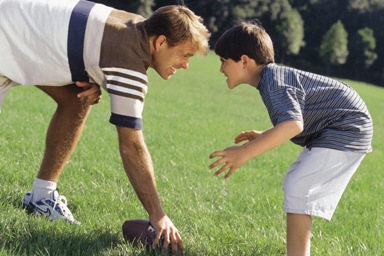
This fall I’ve taken my kids to three college football games. One of the unintended consequences of this activity is that they think I don’t know a darn thing about how to play the game.

Take Saturday, for example. I take the kids to the park so we can play football. I divide everyone up into teams and hand the ball to my oldest kid. He gives me a quizzical look and hands the ball back to me.

“We can’t play yet,” he says.

“Why not?” I reply.

“Because we haven’t run out of the tunnel yet,” he says matter-of-factly.

Now it’s my turn to give him a quizzical look. “What are you talking about?”

“Before the game starts the players run out of the tunnel and you say what team you’re playing for.”

Now I get it. At the games I’ve taken them to, the teams run out of tunnels on the other side of the field. He wants to do the same thing.

“OK,” I say, “run out of the tunnel.

He and his brother run around the park and yell “Denver Broncos!” at the top of their lungs. They run back to me and I hand the ball to him.

“Hike the ball,” I said.

“We can’t Dad,” he said. “You haven’t run out of the tunnel yet.”

“I don’t need to—“

“All the teams run out of the tunnel,” he says. “Oh, and you’re the Indianapolis Colts.”

The Colts? I don’t want to be the Colts. I open my mouth to object but realize it could be worse. He could have asked me to be the Oakland Raiders.

So me and my daughter run around the field and let the world know we’re the Colts. When I get back to the ling of scrimmage the oldest hands me the ball.

“You start,” I tell him.

“No, Dad. You need to kick the ball to us.”

“What?”

“They kick the ball off to start the game,” he says as tosses me the ball.

The kickoff. How could I forget that?

I walk back to the goal line. My boys back up. I kick the ball over their heads. Laughing, they both run after it.  My oldest picks up the ball and I wrestle him to the ground. He jumps up and gets ready to hike the ball to his brother.

“We’re going to get a touchdown!” he says before hiking the ball.

Let the game begin.

Finally Doing National Novel Writing Month

I first heard about National Novel Writing Month (NaNoWriMo) back in 2002. I thought it was a cool idea to try to write a novel in a month. But since I was in a critical relationship month with Marathon Girl, I told myself I’d do it next year. The next year came and I was in the middle of slogging through the first draft of my memoir. It wasn’t a project I could rush so I pushed it off another year. Every November after it seemed like I was working another writing project that couldn’t be rushed, in the middle of edits with a publisher, or had just finished a novel and was too burned out to start a new project.

This year, however, the wrings stars have aligned. The final manuscript of The Third has been sent to the publisher, the second round of the Dating a Widower guide is just about done, and I have an outline for a novel that I wrote over the summer that’s screaming to be started. In short not only am I ready to write the first draft of a novel in a month, I’m positive I can do it.

The goal, at least for me, isn’t to write a publishable manuscript in 30 days. If I didn’t have a fulltime job, a family, and other responsibilities, I could probably come close to cranking out a publishable manuscript in 30 days. My NaNoWriMo goal is to simply write an approximate 80,000 word first draft. If I could do that, I could probably have an editable manuscript by the end of the year.

For those who want to track my NaNoWriMo progress, I’ll add a widget to my home page and the side bar of this blog November 1. (I’d add them now but NaNoWriMo isn’t going to make any of their widgets available until November 1.)

Finally, if any readers or writing friends are giving NaNoWriMo a shot, leave a comment or email me your handle and I’ll add you to my NaNoWriMo buddy list. If you want to add me, my NaNoWriMo handle is abelkeogh.

Looking forward to a month of intensive writing.

Poem: Storm Running

(Inspired by a recent run in a thunderstorm) Storm Running

It’s pouring rain I need to run Thunder roars This will be fun!

I tie my shoes Throw open the door The wind blows hard I want more!

After a mile I’m soaking wet Lightening flashes But hasn’t hit me yet!

Halfway through It starts to hail I pick up the pace I will not fail!

The storm grows worse The sky’s pitch black Bring it on I won’t turn back!

I pump my fist I finish the run The storm has lost And I have won!

Storm running is fun I’ll never quit Unless by lightening I get hit!

Dating a Widower Book Update

Quick update on the status of the Dating a Widower guide. All the feedback from beta readers was received last week. I appreciate all of them taking the time to read it and give me their thoughts. Though the overall feedback was positive, several beta readers expressed concerns that the book was a little off the mark of what it was trying to accomplish. After taking time to review everything, I’ve decided to rewrite certain sections of the book before it goes to press. So, the book is still on track to come out this year, but with all the rewriting that needs to be done, the release date is going to be pushed back until November. And, yes, I’ll still need about 10 people or so to review the second version. Email me if you’re interested in reviewing the new book.

On the upside, I was finally able to find someone who actually knows how to design book covers. I’m hoping to have it finalized no later than next week. I’ll post it here as soon as it’s ready to go.

Thanks again to all those who took the time to read it and give me feedback.

I Already Wrote THAT Book

The scene: A waiting area at a car dealership. I've brought my laptop so I can write while I wait. An older gentleman with a thick book in his hand takes the seat next to me and glances at my computer screen. Old Man: What you writing, your memoirs?

Me: I already wrote my memoir. I'm working on a novel.

Old Man: ~laughs~ "That's a good one!"

The old man slaps me on the knee, stands up, and walks away.

Update: The guy turned out to be really cool. After he come back to the waiting area we ended up talking. Turns out he's an avid readers and got a kick out of meeting a writer. On his way out the door he told everyone else in the waiting room to buy both my books.

Photo of the Day

The above photograph is the beginning of a 1952 nuclear test explosion approximately 1 millisecond after detonation. Photograph was done by Harold Edgerton using his innovative rapatronic camera.

Oddly beautiful and terrifying at the same time.

Hat tip: NPR

Why People Read

Why People Read

Author James Collins has an essay over at The New York Times where he frets over not being able to remember the plot to most of the books he’s read. Then he wonders why we read books if we can’t remember what’s in them.

After reading Collins’ essay, I scanned my own bookshelves (sorry, I don’t have a Kindle or Nook—yet) to see how many books I could remember the plot. I don’t know if I have a better memory than Collins or just read more interesting books, but I could remember the basic plot and main characters for at least half of the books on my shelf. Surprisingly half that I couldn’t recall included books by some of my favorite authors. But even if I couldn’t recall the plot, I certainly remember how I felt reading pretty much every book on my shelf.

And therein lies the answer to Collins’ question. People read for the same reasons they watch TV or a movie: they want to be transported to another time, place, or world. They look for characters they can identify with. It’s not Elvis Cole or Bilbo Baggins going off to save the day—it’s the reader himself going on these fantastic journeys. They don’t read to remember the plot, they read to escape reality for a short time.

Ironically Collins misses this very point in his essay—despite spending the first two paragraphs recalling how reading Allen Weinstien’s Perjury made him want to read all day instead of boating and fishing while on a summer vacation in New Hampshire. Instead he focuses on the “aesthetic and literary pleasure” and knowledge one gains by reading. This may be something English professors and their students may open a book for but most people just want something that will take them somewhere else.

The books that I can recall the plot and characters the best are the ones that resonated with me most. Growing up I loved reading Batman comics because Batman generally did everything without the help of others or super powers. It was something my loner teenage self could relate to. Those same loner feelings are what draws me to Lee Child’s Jack Reacher novels. Pleasant childhood memories of summer and baseball is why I enjoyed Michael Chabon’s Summerland and David Horowitz’s autobiography Radical Son struck a chord politically.

Though Collins never figures out why people read, at least he doesn’t feel that time spent reading was a waste of time. But since he’s a writer, Collins better figure out why people read if he wants to have a shot at becoming successful.

The Third Q&A

Q: I’m excited that The Third found a new home. Who’s publishing it? A: Cedar Fort. The same publisher who took Room for Two.

Q: I can’t wait to read it. Any idea when it will be released?

A: The tentative release date is between April-June 2011. But that could change. When I get a more firm date, I’ll post it here.

Q: Did you think you’d find a new publisher so soon?

A: I was a little surprised, yes. I thought I was looking at least a year before I could share good news with everyone. When you have a good story, it makes it easier to find a publisher.

Q: I’ve read some sample chapters and love them. Are you planning on more stories with Ransom, Teya, and Dragomir?

A: I have a sequel to The Third that’s halfway done. The sales of The Third will drive whether or not I finish it. In the meantime, I’m busy with other writing projects.

Q: Other writing projects? Like what?

A: I’m working on a short guide for women dating widowers. I’m hoping to have that out in the next month or two. I also have another novel—unrelated to The Third—that’s in the first draft. I’m hoping to have that one finished by the end of the year.

Q: Can you give us any hint on what that book's about?

A: Not right now. It's too early in the process to know if it's going to be worth publishing.